

Tsagaan Sar: a traveller’s guide to the Mongolian Lunar New Year
Customs, food, greetings and the shamanic meaning of the “White Moon” — and how to celebrate it with a nomadic family in 2027.
Each winter, when the steppe still lies under snow, Mongolia celebrates its most important festival: Tsagaan Sar, the “White Moon”. For three days, families gather, honour their elders, share mountains of dumplings and exchange blessings for the year to come. For a traveller, being welcomed into a nomadic home at this time is one of the most moving experiences Mongolia can offer.
What is Tsagaan Sar?
Tsagaan Sar marks the first day of the year in the Mongolian lunisolar calendar. Its name means “White Moon” (or “White Month”): white is the colour of milk, of purity and of new beginnings, and dairy products take pride of place on every table. The festival celebrates the end of the hardest months of winter and the coming of spring, and it is above all a family celebration, often compared to Christmas in Europe.
The celebration lasts three days. In the capital as in the countryside, Mongolians put on their finest deel, the traditional long robe, and travel — sometimes very far — to visit the oldest members of their family.
When is Tsagaan Sar in 2027?
The date changes every year, as it follows the lunar calendar. It usually falls between late January and late February. In 2027, Tsagaan Sar is celebrated on 8 February, according to the Mongolian lunar calendar. The festivities then continue over the following days, as families visit one another.
Bituun: the eve of the New Year
The day before Tsagaan Sar is called Bituun, the night of the dark moon that closes the old year. It is a day of preparation and of closure. Families clean their home from top to bottom and herders clean their animal shelters. Debts are repaid and disputes are settled, so that nobody enters the new year carrying the weight of the old one.
In the evening, the family gathers for a generous meal of dairy products and buuz, eating until everyone is full: entering the year with a full stomach is a promise of abundance.
The first day: greetings and blessings
On the morning of Tsagaan Sar, many Mongolians rise early, and the whole family meets at the home of the eldest. The most important gesture of the day is the zolgokh, the traditional New Year greeting.
- The younger person holds out their arms, palms up, and supports the elder under the elbows — a gesture that says “I will support you”.
- A khadag, a long ceremonial silk scarf, usually blue like the sky, is often held across the hands during the greeting.
- The traditional words are “Amar baina uu?” — “Are you living in peace?”
- Guests and hosts may also exchange snuff bottles, offered and returned with great courtesy, as a sign of respect.
Amar baina uu? — Are you living in peace?
Then come the visits: from yurt to yurt and from flat to flat, families welcome a constant stream of relatives and friends. Each guest is greeted, offered milk tea and invited to eat.
The Tsagaan Sar table
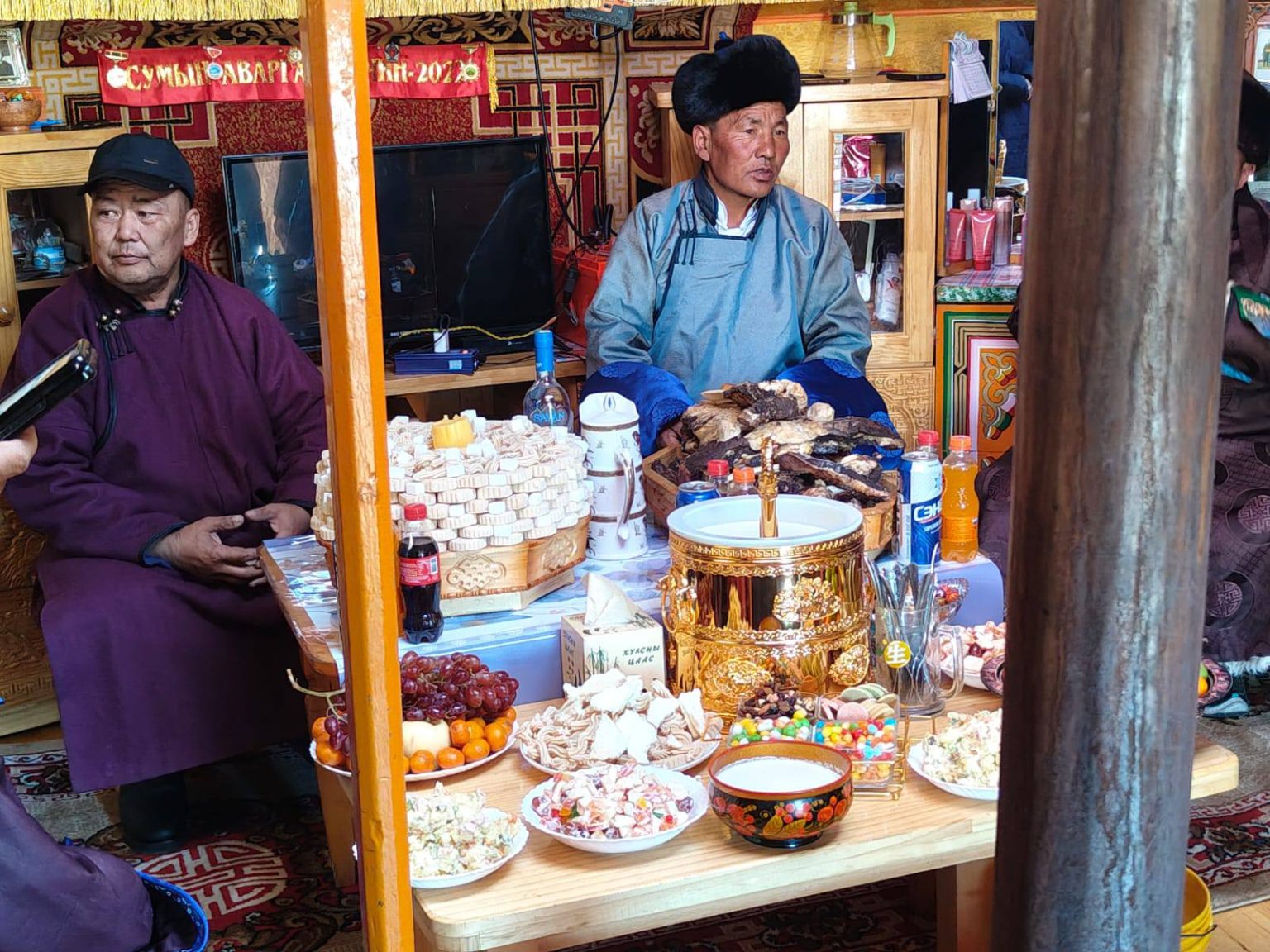
The New Year table is a symbol of abundance and is prepared days in advance.
- Buuz: steamed dumplings filled with meat. Families prepare them together by the hundreds, sometimes by the thousands, in the days before the festival.
- Ul boov: a tower of layered pastries, decorated with dairy products and sweets. Its number of layers is symbolic, and it is as much an offering as a dessert.
- A whole sheep’s back, the centrepiece of the meal in many homes.
- Dairy products: dried curds (aaruul), cream, and suutei tsai, the salted milk tea served all day long. In some families, airag (fermented mare’s milk) is also shared.
Be prepared: during Tsagaan Sar there are no fixed mealtimes. You will be offered food morning, noon and night — and it is polite to at least taste what is offered.
The shamanic meaning of the White Moon
For the peoples of the steppe, the turning of the year is also a spiritual threshold. Tsagaan Sar is a time to honour the ancestors, the sky (Tengri) and the spirits of the land, and to start a new cycle with a pure heart. Offerings of milk and of the first portion of food are made to the spirits, and many families visit an ovoo, a sacred cairn, walking around it three times in the direction of the sun while making a wish.
Shamans also open the new year with their own ceremonies of fire, purification and blessing. Experiencing Tsagaan Sar alongside shamans allows you to feel the deeper dimension of the festival: not only a family celebration, but a collective renewal between humans, nature and the invisible.
Etiquette tips for travellers
- Greet the elders first, and let your hosts guide you through the zolgokh.
- Receive with the right hand, supported by the left at the elbow or wrist, especially when you are offered a bowl or a cup.
- Taste what is offered. If you do not wish to drink airag, accept the bowl, touch it to your lips and hand it back.
- In the yurt, do not knock: simply enter, moving to the left, in the direction of the sun. Never point your feet towards the stove, and do not throw anything into the fire — it is the home of the fire spirit.
- Bring a small gift from home for your host family: it is part of the tradition of exchange.
- Dress warmly. Temperatures in February can drop well below −20 °C. A deel, if you have the chance to wear one, is the warmest and most appreciated outfit.
Celebrate Tsagaan Sar with us in 2027
Live Tsagaan Sar with a nomadic family
Our journey Shamanism and Tsagaan Sar in Mongolia (3 – 18 February 2027) invites you to celebrate the New Year as a guest of a nomadic family in the Khogno Khan region, sleeping in heated yurts. You will help prepare the buuz, share the zolgokh with the family, and take part in shamanic ceremonies of welcome, fire and gratitude — before relaxing in the natural hot springs of Tsenkher, in the heart of the frozen landscape.
The journey is designed by our founder, Chimegmaa Orsoo, who was born in Mongolia, in small groups of 9 to 16 travellers.
Frequently asked questions
What does Tsagaan Sar mean?
Tsagaan Sar means “White Moon” or “White Month” in Mongolian. White symbolises purity, milk and new beginnings.
How long does Tsagaan Sar last?
The main celebration lasts three days, with three days of public holiday in Mongolia. Visits to relatives often continue for several days afterwards.
Is Tsagaan Sar the same as Chinese New Year?
Both are lunar new year festivals and often fall on the same day, but not always: Mongolia follows its own lunisolar calendar, and its customs — the zolgokh, the snuff bottles, the buuz and the white foods — are distinctly Mongolian.
Can tourists take part in Tsagaan Sar?
Yes, as guests. Tsagaan Sar is a family celebration, so the best way to experience it is to be welcomed by a family, with a guide who explains the customs. This is exactly what our February journey offers.
Is it too cold to travel to Mongolia in February?
It is cold, often well below freezing, but the air is dry and the sky is usually clear and sunny. With good winter clothing and heated yurts, the Mongolian winter is a magical experience. We send a detailed clothing list before departure.
Explore also our Festival & Celebration journeys and all our shamanic journeys.